
Hartford County Court Records After a Jail Arrest
An arrest is the start, not the finish. Police take a person in, run booking, and may release on a promise or hold for court. If the person is not released, Connecticut Department of Correction takes custody at a pretrial facility. None of that decides the charges. A prosecutor reviews the case and files the formal charges. Those filed charges are the Hartford County court record. They carry a docket number, a court location, and a status that updates as the Hartford County case moves. The path runs from arrest to booking, then to a bail or pretrial interview, then to a first appearance and arraignment, and then to charges filed by the state.
The custody side and the court side are two different Hartford County records. For the booking entry, the housing facility, and the custody status, use the jail inmate records page, and for booking photos see the jail roster mugshots page. The Hartford County court record is separate. It shows the charges the state actually filed, the next event, and the disposition. Arraignment is the first court date where a judge reads the charges and sets release terms. After an arrest in Hartford County, the court file is where the real charges and the case outcome live.
Which Hartford County Court Holds the Case
Hartford County has no county criminal court. Arrests route into Connecticut Superior Court. Which courtroom hears the matter depends on the town, the charge level, and the defendant. The most serious Hartford County felonies go one way. Lower charges and motor vehicle cases go another. A few key venues cover most Hartford County arrests, and each one ties to a set of towns.
Part A of the Hartford Judicial District handles the heaviest Hartford County cases, mostly Class A and B felonies from across the district. The geographical area courts, called G.A. courts, take the rest. A G.A. court is the local Hartford County Superior Court venue that handles lower felonies, misdemeanors, infractions, and motor vehicle offenses. G.A. 14 in Hartford and G.A. 12 in Manchester split the county by town, and Hartford Community Court runs as its own venue.
| Court | Handles | Towns Served |
|---|---|---|
| Hartford Judicial District / Part A | Class A and B felonies | All towns in the Hartford Judicial District |
| G.A. No. 14, Hartford | Class C, D, E felonies, misdemeanors, infractions, motor vehicle | Avon, Bloomfield, Canton, Farmington, Hartford, West Hartford |
| G.A. No. 12, Manchester | Class C, D, E felonies, misdemeanors, infractions, motor vehicle | East Hartford, Glastonbury, Manchester, Marlborough, South Windsor |
| Hartford Community Court | Lower-level community cases, separate venue | Hartford |
Note: A missing result in one court does not close the search, because a case may sit under a different G.A. code than the arrest town first suggests.
How Prosecutors File Hartford County Charges
Connecticut has no county district attorney. The Division of Criminal Justice runs prosecution through State's Attorneys for each judicial district. Sharmese L. Walcott is the State's Attorney for the Judicial District of Hartford. She was appointed September 25, 2020 and serves as the chief law enforcement officer for the district, which covers about 590,000 residents across nineteen towns.
The towns inside the Hartford prosecutorial district are Avon, Bloomfield, Canton, East Granby, East Hartford, East Windsor, Enfield, Farmington, Glastonbury, Granby, Hartford, Manchester, Marlborough, Simsbury, South Windsor, Suffield, West Hartford, Windsor, and Windsor Locks. An arrest in any of those towns runs through the Hartford State's Attorney's office. Charges at a Hartford County arrest are not final charges. The prosecutor reviews the case and decides what to file. Charges can be filed as written, amended, reduced in a plea, replaced by a substitute information, dropped through a nolle, or, in serious cases, taken to a grand jury for an indictment.
The Hartford State's Attorney detail is published on the Hartford Judicial District State's Attorney page, which lists the office leadership and the towns served.
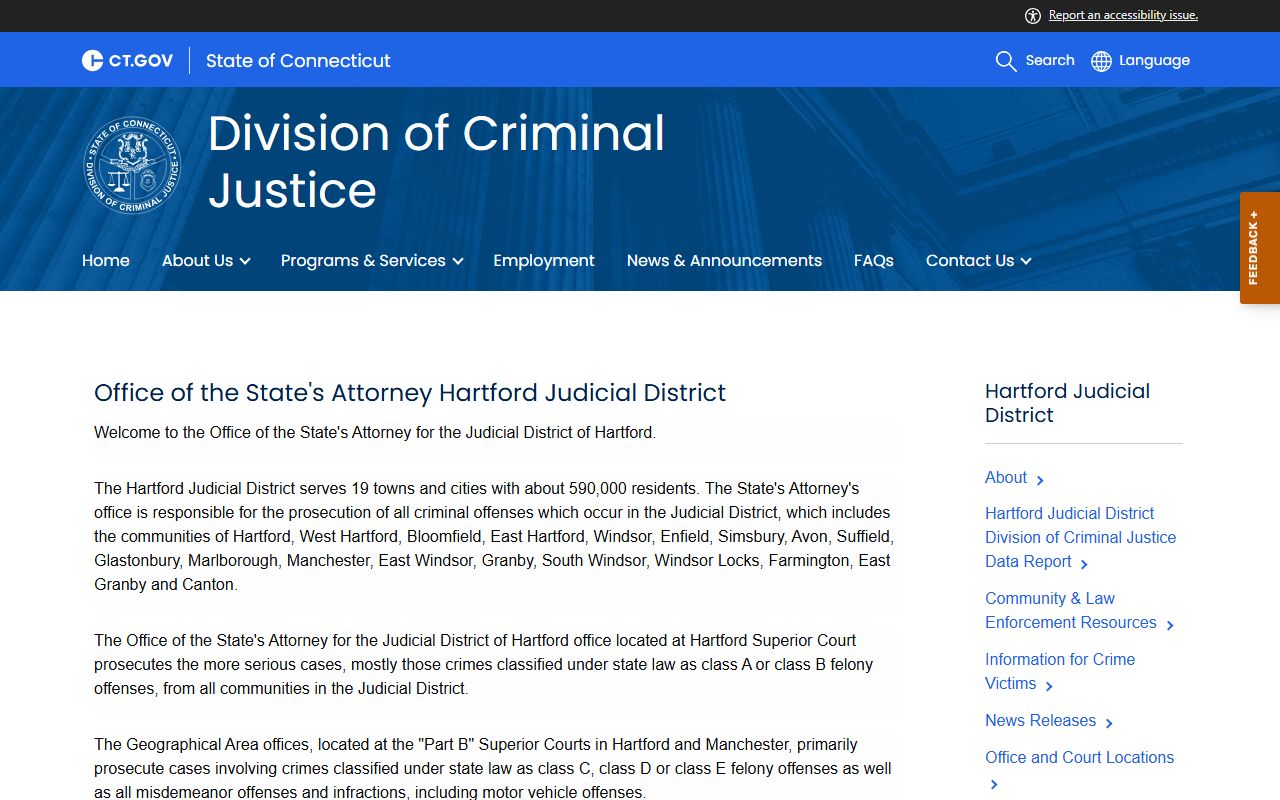
That page is the source for who files Hartford County charges and which towns fall under the district. The office addresses and phone numbers appear in the contact grid below.
| Office | Address | Phone |
|---|---|---|
| State's Attorney, Judicial District of Hartford (Part A) | 101 Lafayette Street, Hartford, CT 06106 | (860) 566-3190 |
| State's Attorney, G.A. No. 14 | 101 Lafayette Street, Hartford, CT 06106 | (860) 566-5996 |
| State's Attorney, G.A. No. 12 | 410 Center Street, Manchester, CT 06040 | (860) 649-4779 |
| Hartford Community Court | 80 Washington Street, Hartford, CT 06106 | (860) 756-7815 |
Charging Documents in the Court File
The booking record happens at the jail. The Hartford County court record begins when a charging document is filed. Connecticut court files can hold several document types. A summons and complaint or an infraction complaint can start a lower case. An information, or a substitute information, is the prosecutor's formal charge sheet for most cases. An indictment comes from a grand jury for the most serious matters. The same file may also hold the executed arrest warrant, the warrant affidavit, a uniform arrest report, plea papers, probation orders, and the judgment mittimus, which is the order that commits a sentenced person to custody.
| Summons / Complaint | Information | Indictment | |
|---|---|---|---|
| Filed By | Officer or prosecutor | Prosecutor (State's Attorney) | Grand jury |
| Common For | Infractions, lower charges | Most misdemeanors and felonies | Most serious felonies |
| Can Be Changed | Yes | Yes, by substitute information | By the grand jury process |
| Starts | The case | The case | The case |
Most Hartford County cases proceed by information. The substitute information matters because it lets the state swap in different charges as the Hartford County case develops. That is one reason the charges on a Hartford County court docket can differ from the charges listed at booking.
The Connecticut Court Records Lookup
The Connecticut Judicial Branch runs the statewide case lookup. It is the main tool for Hartford County court records after an arrest. The menu splits into separate searches, so picking the right one saves time on a Hartford County case. There is a pending case search, a conviction search, a daily docket, a docket number search, an attorney case lookup, and a warrant search. Each search runs against the court files, not the jail roster.
The lookup menu lives on the Judicial Branch criminal and motor vehicle case lookup page, which links to every search type in one place.
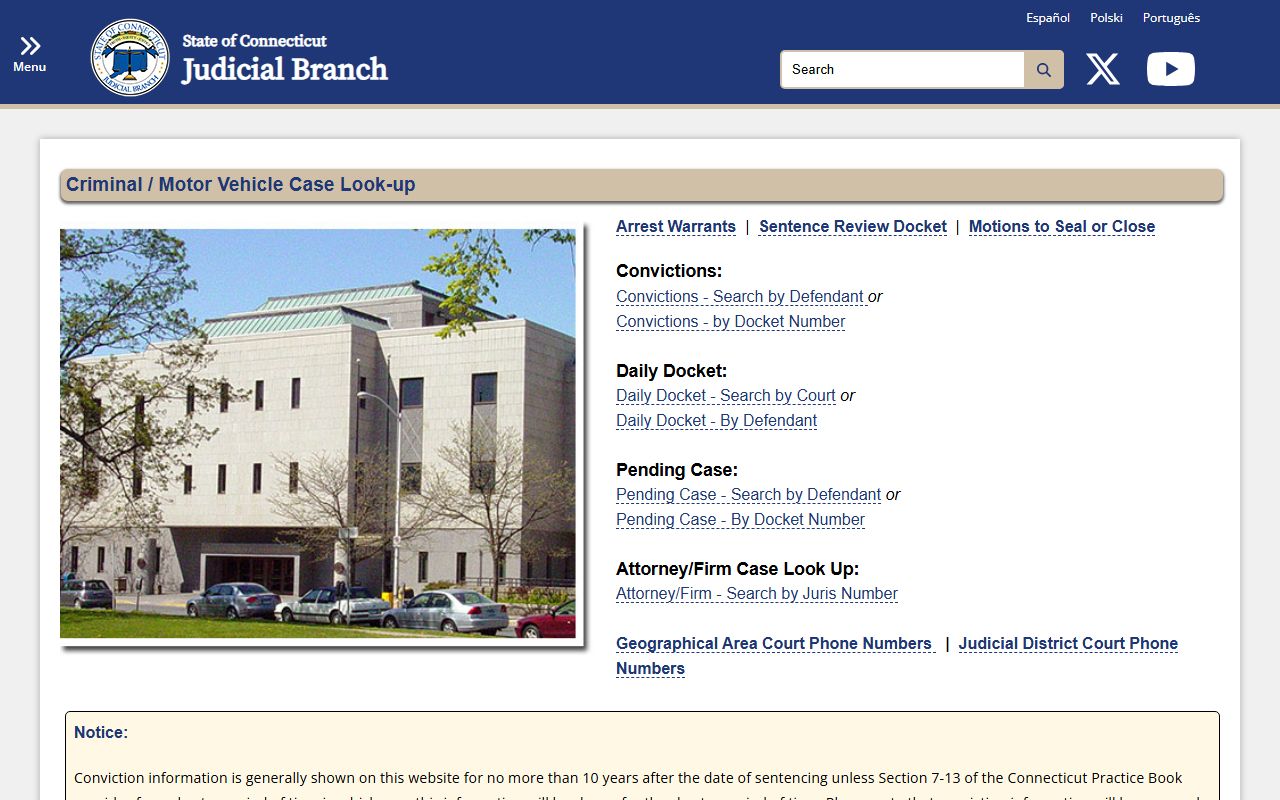
From that menu, a pending case search is the right start for a recent Hartford County arrest, while a conviction search fits older or closed cases. The search types break down like this:
- Pending case by defendant or by docket number, for active cases.
- Conviction by defendant or by docket number, for closed cases.
- Daily docket by court or by defendant, for scheduled hearings.
- Arrest warrants for probation violations and missed court dates.
Pending Hartford County Case Search
For a fresh Hartford County arrest, the pending case search by defendant is the place to look. It runs on a last name, and a first initial, birth year, and court location can narrow a broad result. The form also lets a user pick a category, such as criminal or motor vehicle. The Hartford-area court locations in the dropdown include Hartford Community Court, Hartford G.A. 14, Hartford J.D., Manchester G.A. 12, and the statewide courts.
The pending case search by defendant is reached through the CT Judicial pending case lookup, which displays the fields below and an "information is accurate as of" timestamp.
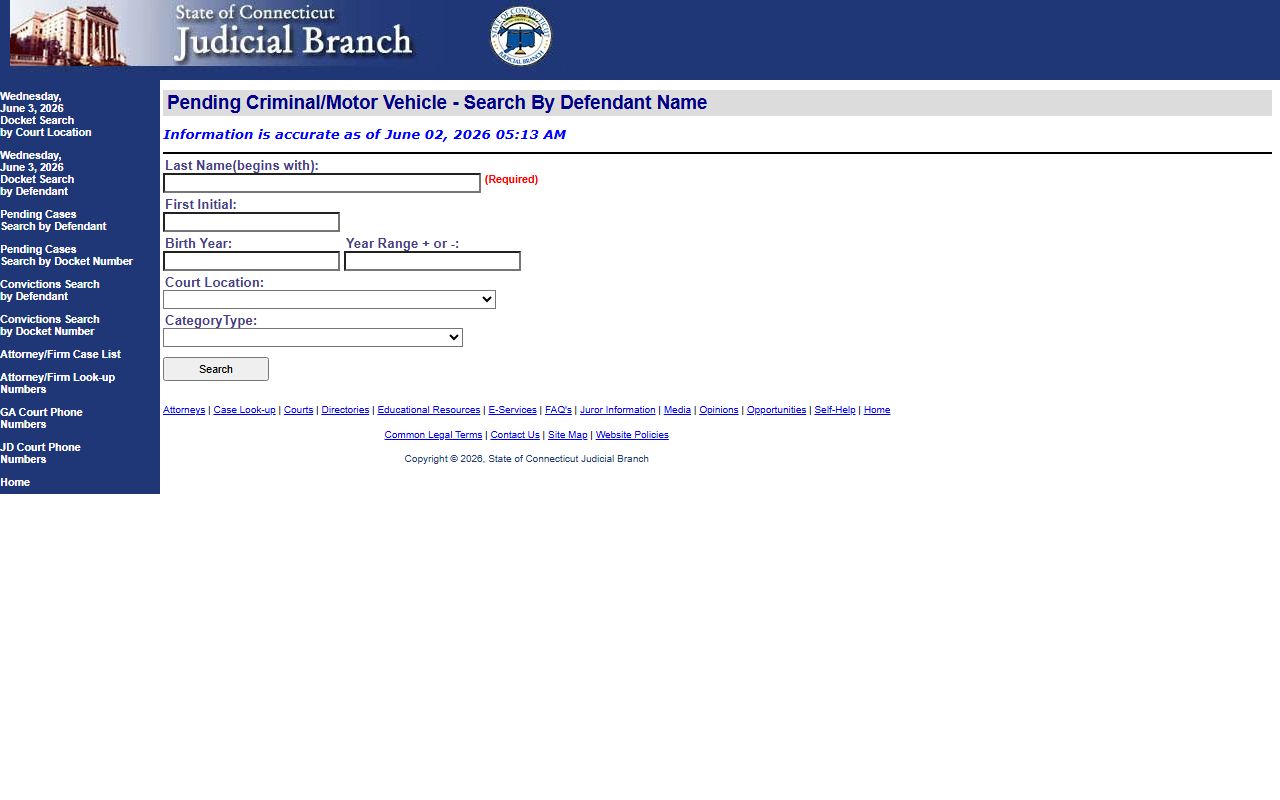
That form is the workhorse for finding a recent Hartford County case. Start with the last name alone, then add the other fields only if too many results come back.
| Field | Type | Notes |
|---|---|---|
| Last Name (begins with) | Text | Maxlength 60 |
| First Initial | Text | Maxlength 1 |
| Birth Year | Text | 4 digits |
| Year Range + or - | Text | Maxlength 1 |
| Court Location | Dropdown | Hartford Comm Court, Hartford G.A. 14, Hartford J.D., Manchester G.A. 12, statewide |
| Category Type | Dropdown | Criminal; Motor Vehicle; license/registration suspension referrals |
To find the charges filed after an arrest, work in order:
- Note the arresting agency and arrest date from the police log or arrest report.
- Check Connecticut Department of Correction custody status if the person was held.
- Search pending cases by last name, then add first initial, birth year, or court location.
- If no pending case shows, try the docket number search or the conviction search.
- Compare the booking charges to the court charges, since they may not match.
Hartford County Conviction Court Records
Closed Hartford County cases move out of the pending search. The conviction search by defendant covers them. It uses the same field set as the pending search: last name, first initial, birth year, year range, court location, and category. The Hartford-area court options include Hartford Community Court, Hartford G.A. 14, Hartford Housing, Hartford J.D., and Manchester G.A. 12. A docket number search is also available when the case number is known.
The conviction search runs through the CT Judicial conviction lookup by defendant, and the same page carries a display warning that limits what shows.
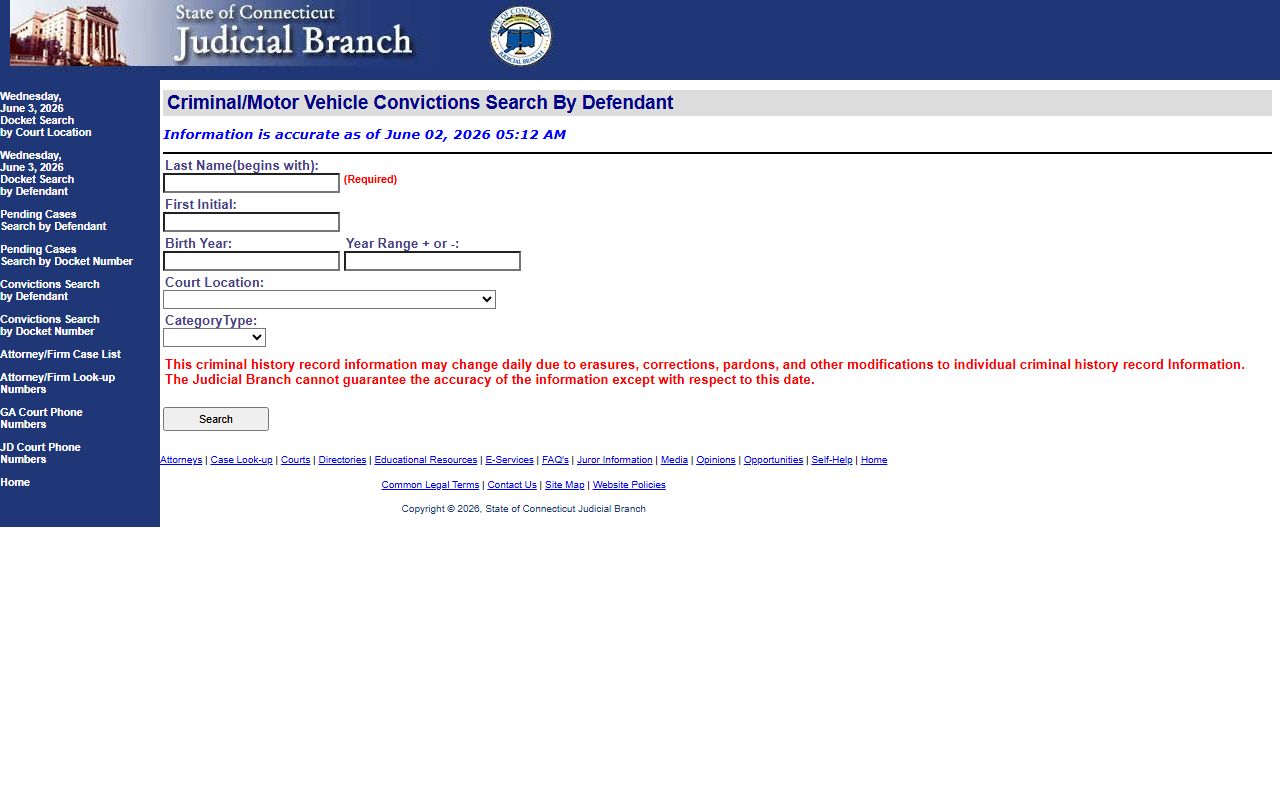
That warning is important for any conviction search. The online display is not the full court file.
Conviction display limit: Conviction data generally shows for no more than ten years after sentencing, youthful offender, juvenile, and infraction cases are not shown, and erasures, pardons, and corrections can change results daily.
When online display runs short, the docket number search can still pull a case by its court code, case type, year, and number. If a record no longer appears online, the full Hartford County file may still exist at the courthouse and can be requested in writing.
Hartford County Charge Status Terms
Charges change as a Hartford County case moves. The status on a court docket is the clearest signal of where things stand. Booking charges on the custody record can differ from the charges the prosecutor finally files. The Hartford County court file controls. The common terms are worth knowing before reading a docket.
- Pending
- The case or charge is active and not yet resolved.
- Amended or substitute information
- The prosecutor changed the formal charging document.
- Reduced
- A charge was lowered through a plea or a prosecution decision.
- Dismissed
- The court dismissed the charge.
- Nolle prosequi
- The prosecutor declined to pursue the charge; erasure timing can apply after the statutory period.
- Guilty / not guilty
- A conviction follows a guilty plea or verdict; a not-guilty finding is an acquittal, and erasure rules can apply.
A nolle is not the same as a dismissal. It pauses the Hartford County charge, and the state can revive it within the statutory window before erasure applies. Reading these terms correctly keeps a court record from being misread.
Bond and Release After a Hartford County Arrest
Connecticut does not run release through a county sheriff bail desk. Hartford County pretrial release runs through police custody, the Judicial Branch Court Support Services Division, bail commissioners, and the Superior Court. Pretrial Services interviews people held after arrest, people waiting for arraignment, and people held on bond. Intake assessment and referral specialists work regular court hours. Bail commissioners cover the off-hours, working 6:00 p.m. to 4:30 a.m. daily so release decisions can happen before court opens.
The pretrial and bail process is described on the Judicial Branch Court Support Services Division bail page, which outlines the interview and the release conditions.
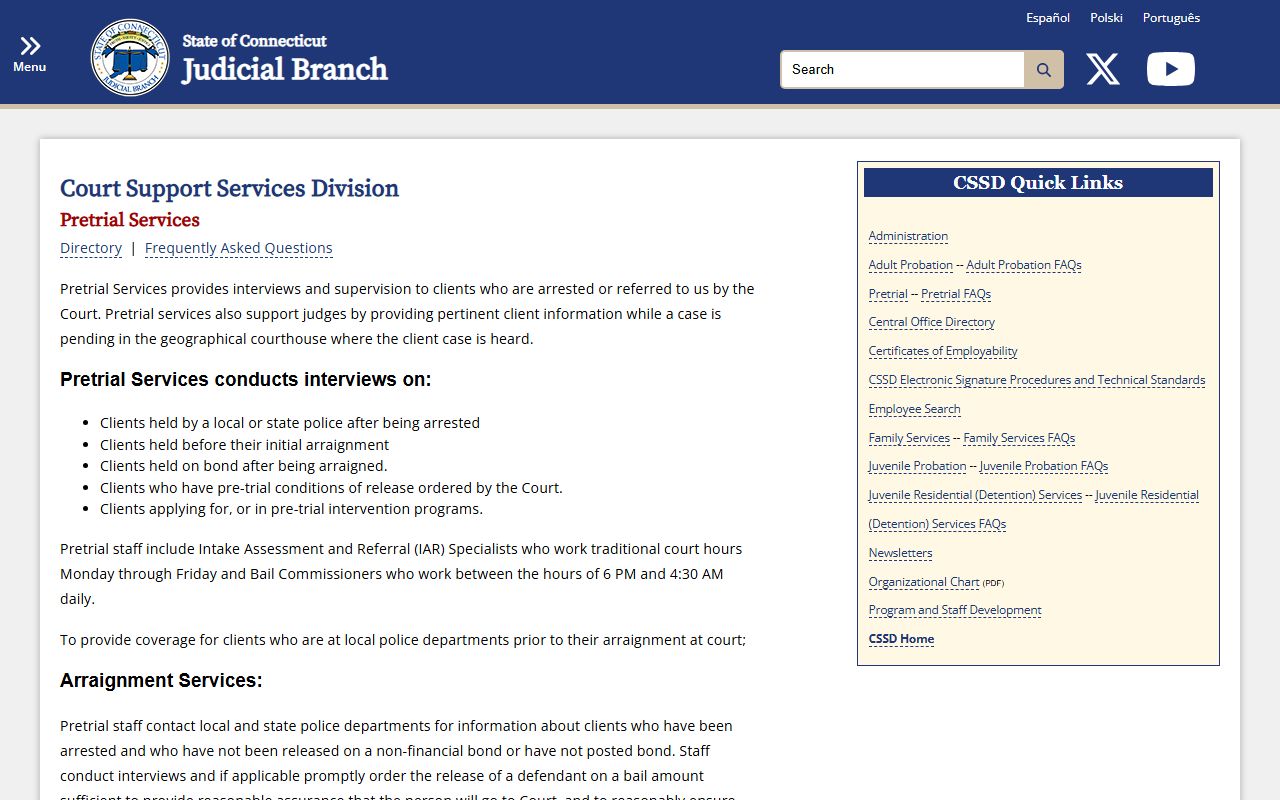
State law sets how release is decided. Under C.G.S. § 54-63b, the Court Support Services Division runs pre-arraignment interviews and makes release recommendations. Under C.G.S. § 54-63d, a bail commissioner can release a person on the first sufficient condition before court. Under C.G.S. § 54-64a, the Superior Court must use the least restrictive condition that reasonably ensures the person returns, and a judge may not block a surety bond from being posted.
| Release Type | How It Works |
|---|---|
| Written promise to appear | Release on the person's written promise to come to court. |
| Promise with nonfinancial conditions | Release with terms such as supervision, travel limits, no-contact orders, or treatment. |
| Bond without surety | A bond obligation set with no commercial surety. |
| Bond with surety | A bond posted through a surety or bail bond agent. |
| Deposit condition | In limited cases, the court may require a percentage deposit, such as 30 percent. |
| Committed to DOC | If release is denied or conditions are not met, the person is held by the Commissioner of Correction until released by law. |
To post bond after a Hartford County arrest, use the paperwork and instructions from the arresting police agency, the bail commissioner, or the court. If the person is already committed to custody, confirm status through both the court record and Hartford Correctional Center.
Note: Because Hartford County custody is state-run, a bond question often needs both the court side and the Department of Correction facility side to get a full answer.
Warrants and Failure to Appear
An outstanding warrant can put a person back in custody, and from there into the Hartford County court record again. The Connecticut Judicial Branch runs a public search for arrest warrants tied to probation violations, failures to appear, and orders to incarcerate. It is not a full warrant database. The page warns that it does not list all warrant types and tells users not to act against anyone based on the site. For an immediate threat, the guidance is to call 911 or local police.
The warrant search runs at the CT Judicial arrest warrant lookup, which checks for violation of probation, failure to appear, and orders to incarcerate.
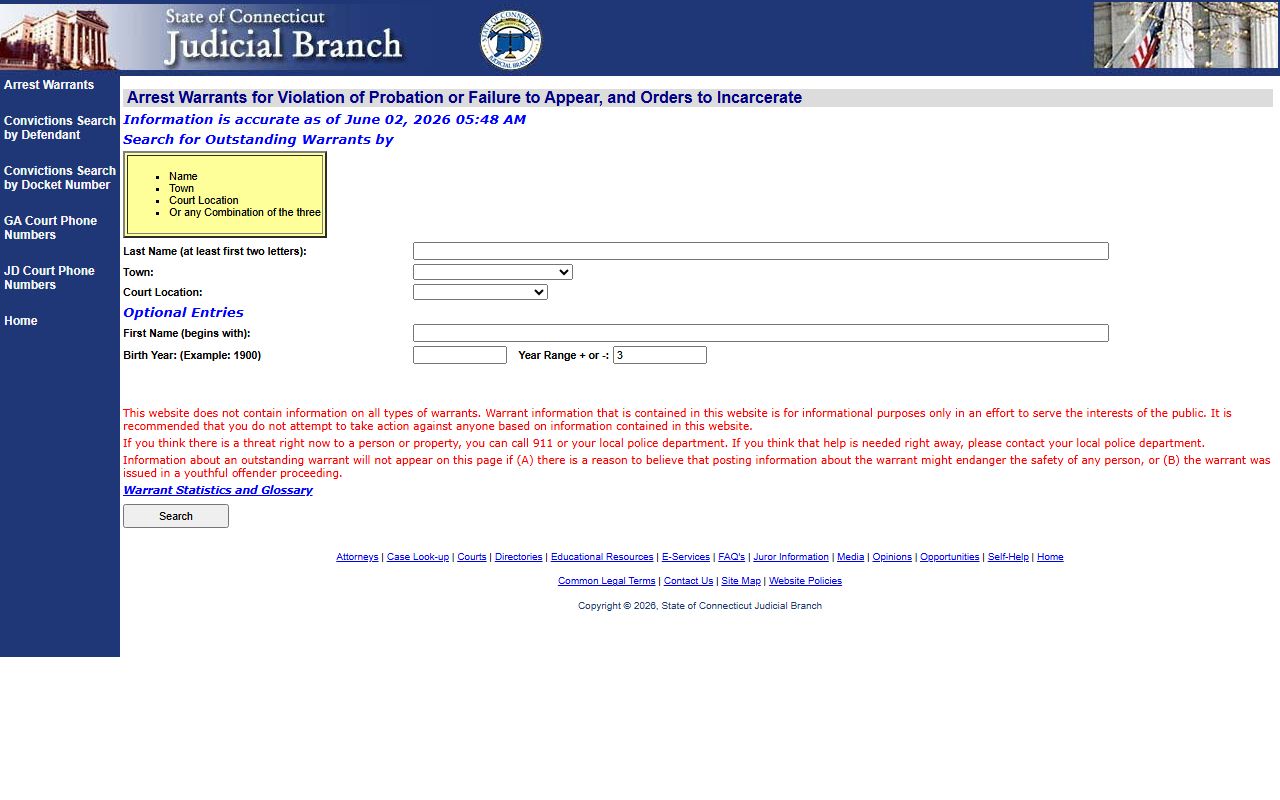
The form searches by last name, with options for town, court location, first name, and birth year. Hartford County towns in the dropdown include Hartford, East Hartford, West Hartford, Manchester, New Britain, Enfield, Farmington, Glastonbury, Windsor, and others. A blank result is not proof that no warrant exists.
Warrant search limit: The search covers only certain warrants, does not authorize private action, and may omit youthful offender or safety-sensitive warrants, so a missing result does not clear a person.
Hartford County Court Record Copy Requests
Online display is not the entire court file. When a Hartford County record is limited online, or older than the display window, the full file can be requested. The Judicial Branch says a criminal or motor vehicle record search should first be made in writing to the geographical area court where the arrest occurred. The request should include the name, the date of birth, and, if possible, the date of arrest or disposition. The search is limited to records held at that court location.
The court records process is explained on the Judicial Branch court records FAQ, with copy and search detail continued on the follow-up FAQ page.
| Record Type | Copy Fee |
|---|---|
| Court records and documents | $1 per page |
| Administrative records | $0.25 per page |
A Hartford County court file may include the executed arrest warrant, the warrant affidavit, the information or indictment, plea papers, probation orders, and the judgment mittimus. Public access exists unless a court sealed the file or a statute makes the contents confidential.
Pending Charge vs. Conviction Record
A charge is an accusation. A conviction is an outcome. They are not the same record, and they should never be read the same way. Being arrested and charged in Hartford County does not mean a person was convicted. The two Hartford County records stand at different stages and carry very different weight.
| Pending Charge | Conviction Record | |
|---|---|---|
| Stage | Accusation, case still open | Guilty plea or verdict, case closed |
| Proof Standard | Probable cause | Proof beyond a reasonable doubt |
| Where It Shows | Pending case search | Conviction search |
| Can Change | Yes, may be amended, reduced, nolled, or dismissed | Final unless appealed, pardoned, or erased |
Because charges shift, the pending Hartford County docket is a snapshot, not a verdict. A booking charge can be reduced or dropped long before any conviction record exists. Reading both the right way prevents a serious mistake.
Erased Record vs. Public Record
Connecticut does not use the words sealing or expungement for its main cleanup law. The correct frame is erasure. Under C.G.S. § 54-142a, qualifying records can be erased after a not-guilty finding, a dismissal, a nolle that has aged past the statutory period, an absolute pardon, or an eligible Clean Slate conviction. Erasure means the Hartford County record is treated as if the arrest and case never happened for most purposes.
| Erased Record | Public Record | |
|---|---|---|
| Visibility | Removed from public access | Open to inspection unless exempt |
| Legal Effect | Treated as if it never occurred | Counts as part of the case history |
| Online Display | Drops from the case lookup | Shows within the display window |
The state Clean Slate program automates erasure for some convictions, and guidance is published at the official Connecticut Clean Slate page. Erasure is also why a Hartford County conviction search can change from one day to the next, and why a court record once visible may later vanish from public view.
Note: Erasure removes qualifying court, police, and prosecutor records, but a person should verify the result with each agency that held the original record.